Home Explore All FAQs Skin Science FAQ Demodex FAQ Skin Conditions FAQ Ingredients FAQ Products FAQ Shop
Home / Explore All FAQs / Demodex Mites FAQ
Demodex Research & Skin Science

Understanding Demodex

Scientific insights into Demodex mites, their life cycle, follicular environment, and presence on the skin, scalp, and eyelid margins.

Microscopic Mite

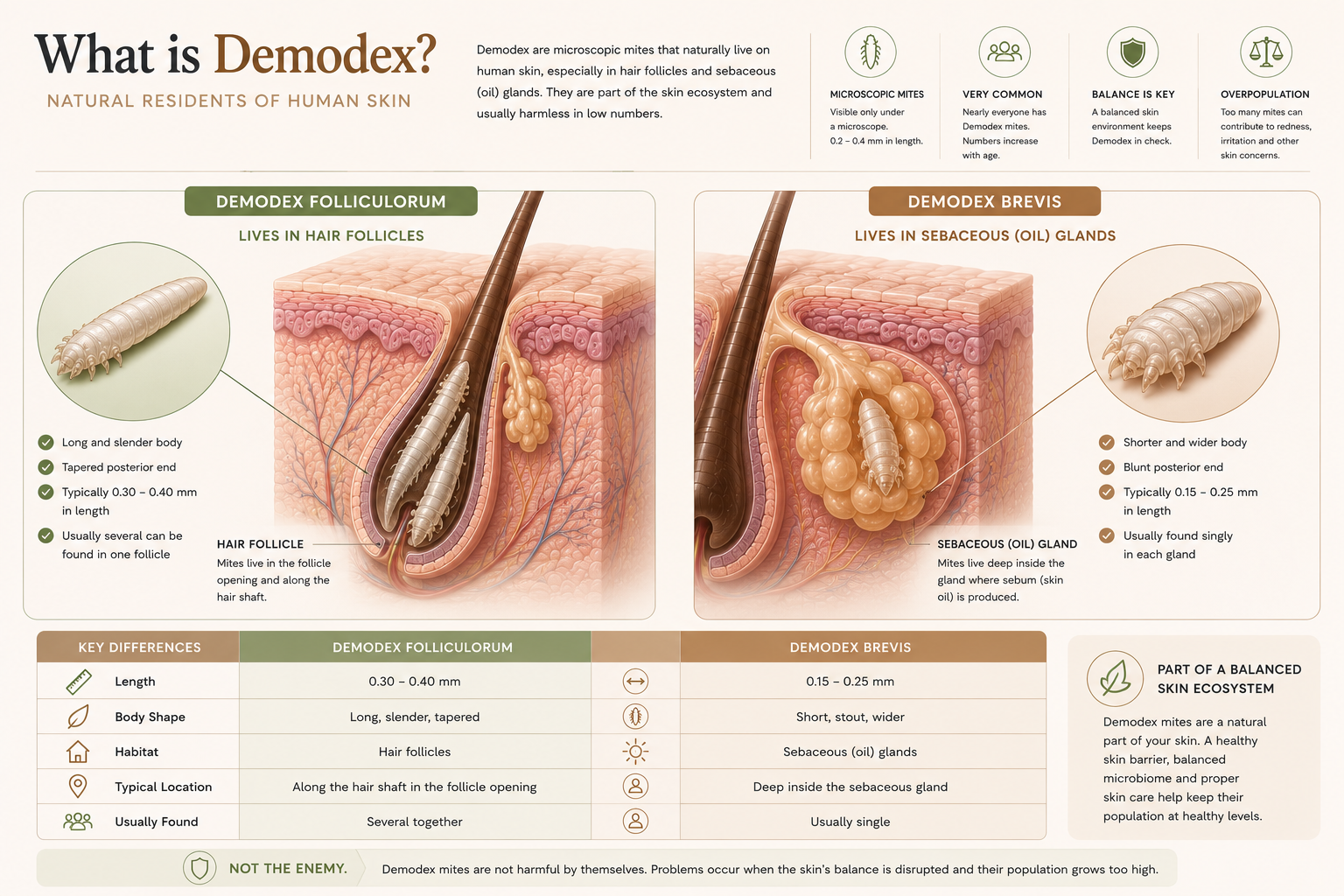
What is Demodex?

Illustration of a Demodex mite
Figure 1: Illustration of a Demodex mite and its characteristic elongated body structure.

Demodex are microscopic mites that naturally live on human skin. They are found primarily in hair follicles and associated sebaceous (oil) glands, particularly on the face, including the cheeks, nose, forehead, and chin. They live within this sebum-rich follicular environment and feed on material found within and around the follicles. Demodex mites are commonly found on the skin of healthy adults without causing noticeable problems.

For most individuals, Demodex mites cause no noticeable issues. However, mite density can vary between individuals, and the skin's response to their presence may also differ. In some people, higher Demodex densities or a stronger local immune response may be associated with visible redness, irritation, or other skin concerns.

Scientific research has found an association between increased Demodex density and certain skin and eyelid conditions, particularly rosacea and some forms of blepharitis. However, the relationship is complex, and researchers continue to investigate the precise role Demodex mites may play in skin and eyelid health.

Demodex mites are not inherently abnormal or harmful. Their presence is common in healthy adults, and the skin's response to them can vary between individuals. At Demodex Solutions, our approach focuses on supporting a balanced skin environment through consistent, gentle skincare rather than unnecessarily aggressive routines.

Key Facts: What is Demodex?

  • Demodex mites live primarily within hair follicles and associated sebaceous glands.
  • Adult mites may migrate toward the skin surface, particularly under low-light conditions.
  • Demodex mites feed on material found within the follicular environment.
  • Demodex mites are commonly found on the skin of healthy adults.
Educational Note: This information is provided for educational purposes only and is not intended to diagnose, treat, cure, or prevent any medical condition.
Transmission & Skin Contact

Can Demodex Spread Between People?

Demodex mites can be transferred between people, particularly through close and repeated skin-to-skin contact. Research examining Demodex populations has found that mite lineages are more commonly shared between family members and spouses than between unrelated individuals, supporting close contact as an important route of transmission.

Transfer may also be possible through shared personal items that come into direct contact with the face or eyelashes, such as towels or cosmetics. However, Demodex mites are highly adapted to living within human hair follicles and sebaceous glands, and close skin contact is considered a more important route of transmission than casual contact with the surrounding environment.

Importantly, the presence of Demodex should not be viewed in the same way as a contagious skin infection. Demodex mites are extremely common inhabitants of human skin, particularly in adults, and many people carry them without experiencing any noticeable skin problems.

Key Facts: Demodex Transfer

  • Demodex mites can be transferred between people through close skin-to-skin contact.
  • Research indicates that mite populations are more commonly shared among family members and spouses.
  • Shared towels and cosmetics may provide additional opportunities for transfer.
  • Demodex mites are common inhabitants of healthy adult skin.
  • The presence of Demodex does not by itself mean that someone has a contagious skin disease.
Educational Note: This information is provided for educational purposes only and is not intended to diagnose, treat, cure, or prevent any medical condition.
Identification & Microscopy

How Can Demodex Be Identified?

Demodex mites are microscopic and cannot normally be identified with the naked eye. Their presence can be demonstrated by examining material collected from the skin, follicular contents, or eyelashes under a microscope.

A simple microscopy method can sometimes reveal Demodex in material collected from sebum-rich areas such as the nose or chin. Sebum or follicular material can be gently collected, placed in a drop of oil on a clean microscope slide, covered with a coverslip, and examined under a light microscope. Lower magnification can be used to locate possible mites, while higher magnification, such as 400×, makes their characteristic elongated body and short legs easier to examine.

Not everything visible in a skin specimen is a Demodex mite. Sebum, skin cells, hairs, fibres, and other debris may be present. Adult Demodex mites can be recognized by their characteristic elongated body and four pairs of short legs positioned near the front of the body.

Watch: Recognizing Demodex Under the Microscope

See our microscope demonstration showing Demodex mites within a skin specimen and learn which characteristic features can help distinguish them from sebum, skin debris, and other material.

Watch the Microscope Video →

Important: Finding Demodex in a specimen demonstrates that mites are present, but does not by itself establish that they are responsible for a skin condition. Demodex mites are commonly found on healthy adult skin.

Wondering what changes you may notice during a Demodex-focused skin care routine? Read our guide: Signs Demodex Mites Are Dying: What Changes Can You Expect?

Key Facts: Identifying Demodex

  • Demodex mites are microscopic and cannot normally be identified with the naked eye.
  • Sebum and follicular material can be examined under a light microscope for the presence of mites.
  • Adult Demodex have a characteristic elongated body with four pairs of short legs.
  • Skin debris and other material can sometimes be mistaken for mites.
  • Finding Demodex does not by itself establish that they are responsible for a skin condition.
Educational Note: This information is provided for educational purposes only and is not intended to diagnose, treat, cure, or prevent any medical condition.
Life Cycle & Development

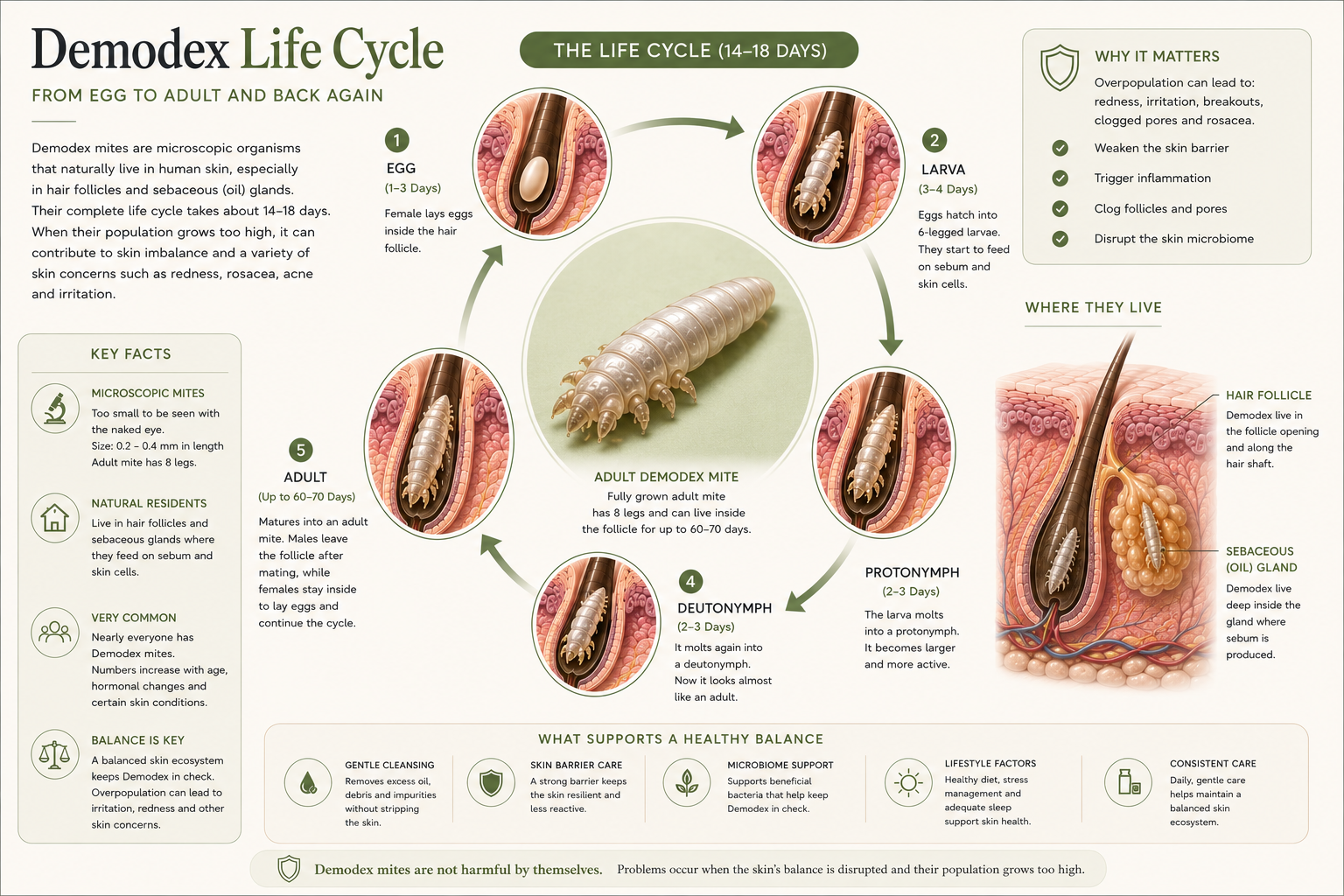
Demodex Life Cycle

Demodex mite life cycle showing Egg, Larva, Protonymph, Deutonymph, Adult and reproduction
Figure 2: Illustration of the Demodex life cycle from egg through larva, protonymph, deutonymph, and adult stages to reproduction.

Demodex mites progress through several developmental stages: egg, larva, protonymph, deutonymph, and adult. The complete life cycle is generally estimated to take approximately 2 to 3 weeks, although timing can vary between species and environmental conditions.

1. Egg Stage: Adult female Demodex mites lay oval-shaped eggs within hair follicles or associated sebaceous glands.

2. Larva Stage: The eggs hatch into six-legged larvae that continue developing within the follicular environment.

3. Protonymph Stage: The six-legged larvae develop into eight-legged protonymphs, an immature stage that continues developing within the follicular environment.

4. Deutonymph Stage: Protonymphs develop into eight-legged deutonymphs, a later immature stage that more closely resembles the adult mite in body form.

5. Adult Stage: Fully developed adult Demodex mites have four pairs of legs and elongated bodies measuring only a fraction of a millimeter in length. Adults may migrate toward the follicle opening and onto the skin surface, particularly under low-light conditions.

6. Reproduction: Adult mites can meet and mate on or near the skin surface. After mating, females move back toward the follicular environment, where eggs are laid and the next generation begins.

Why is the Demodex life cycle relevant to skincare? Understanding the Demodex life cycle helps explain why changes within the follicular environment occur over time rather than overnight. Consistent, gentle skincare over an extended period can support a cleaner, more balanced skin environment and allow time to evaluate how the skin responds to a routine.

Wondering whether this movement can actually be felt on the skin? Read our guide: Can You Feel Demodex Mites Crawling on Your Skin?

For more information about what changes may be noticed over time, see Signs Demodex Mites Are Dying: What Changes Can You Expect?

Key Facts: Demodex Life Cycle

  • Eggs are deposited within hair follicles and associated sebaceous glands.
  • The life cycle progresses through egg, larva, protonymph, deutonymph, and adult stages.
  • The complete life cycle is generally estimated to take approximately 2 to 3 weeks.
  • Adult mites may migrate toward the skin surface, particularly under low-light conditions.
  • Consistent skincare over time can help support a balanced, healthier-looking complexion.
Educational Note: This information is provided for educational purposes only and is not intended to diagnose, treat, cure, or prevent any medical condition.
Follicular Environment

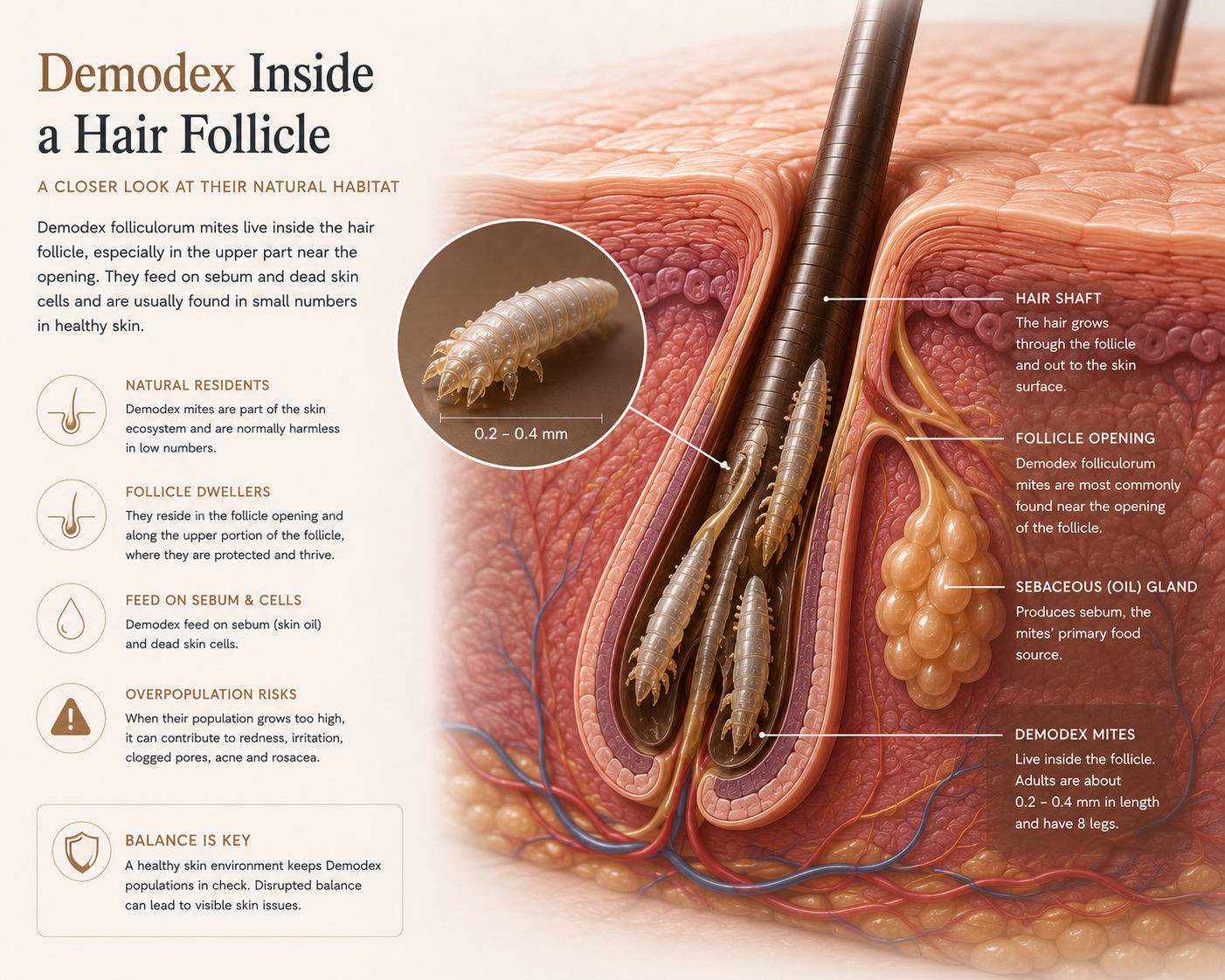
Demodex Inside a Follicle

Illustration of Demodex mites inside a hair follicle
Figure 3: Illustration of Demodex mites positioned within the follicular environment of human skin.

Demodex mites are adapted to living within the narrow environment of human hair follicles and associated sebaceous glands. Their elongated bodies allow them to move within these confined spaces, and multiple mites may sometimes occupy the same follicular unit.

The follicular environment provides access to sebum, cellular material, and epithelial surfaces associated with the hair follicle. The number of Demodex mites present can vary considerably between individuals and across different areas of the skin.

Factors such as age, skin location, sebum levels, and local skin conditions may influence Demodex density. Higher mite densities have been associated with certain skin conditions, but the relationship is complex, and the presence of Demodex alone does not necessarily indicate a skin problem.

For information about the commonly searched question of using hydrogen peroxide against Demodex, see Does Hydrogen Peroxide Kill Demodex Mites?

Key Facts: Follicular Environment

  • Demodex mites live primarily within hair follicles and associated sebaceous glands.
  • Demodex mites have elongated bodies adapted to the narrow follicular environment.
  • Demodex density varies between individuals and across different areas of the skin.
  • Higher mite densities have been associated with certain skin conditions.
  • The presence of Demodex alone does not necessarily indicate a skin problem.
Educational Note: This information is provided for educational purposes only and is not intended to diagnose, treat, cure, or prevent any medical condition.
Scalp Follicular Environment

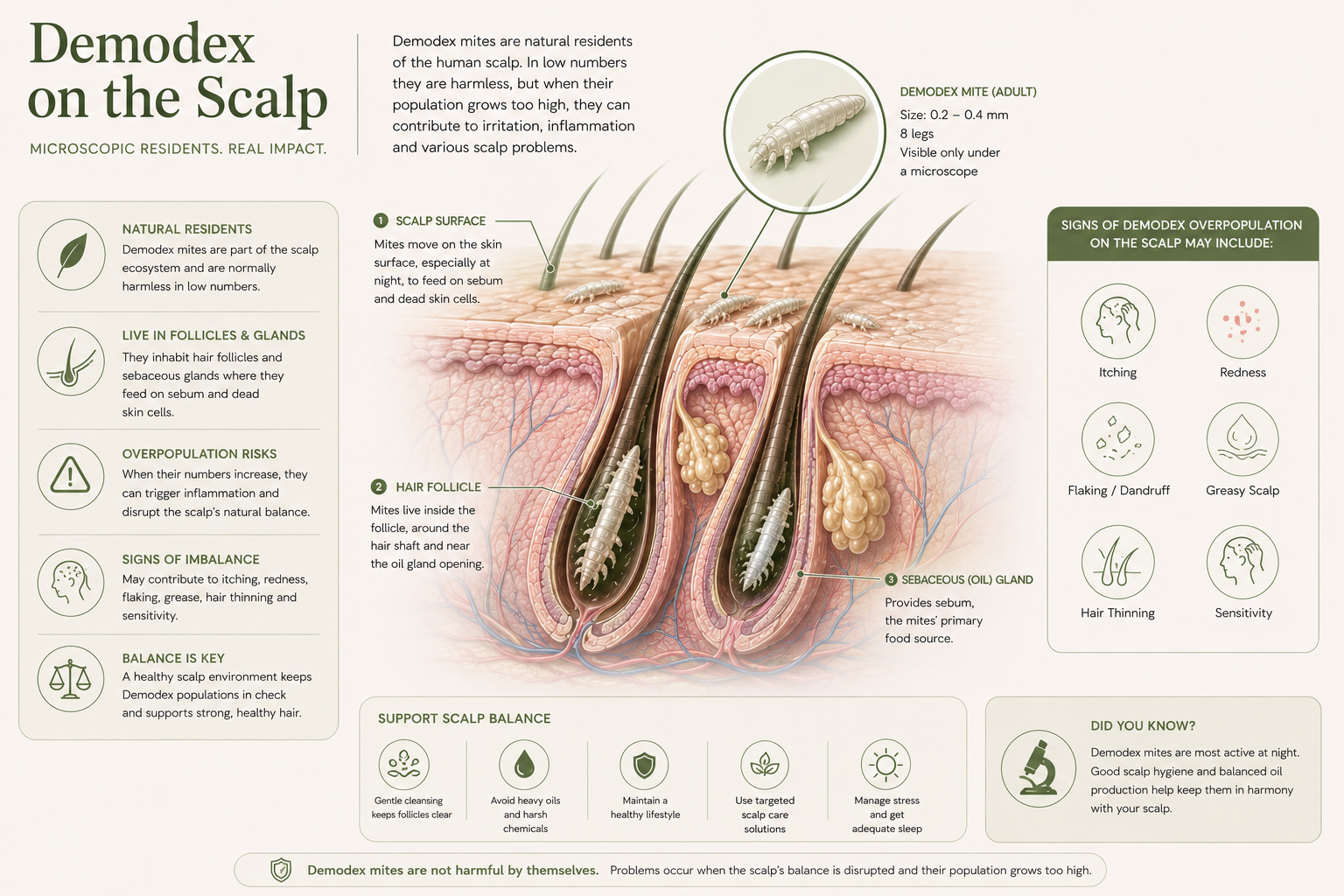
Demodex on the Scalp

Illustration of Demodex mites within hair follicles of the scalp
Figure 4: Illustration of Demodex mites within the follicular environment of the scalp.

The scalp contains numerous hair follicles and associated sebaceous glands, which provide suitable follicular environments for Demodex mites. As on facial skin, Demodex density can vary between individuals and across different areas of the scalp.

In most people, the presence of Demodex on the scalp does not cause noticeable problems. Studies have reported higher Demodex densities in some individuals with scalp-related skin concerns, although the presence of Demodex does not necessarily mean that the mites are the cause. Symptoms such as itching, redness, irritation, and increased oiliness can have many different causes and should not be attributed to Demodex alone.

Regular, gentle scalp cleansing can help remove excess sebum, dead skin cells, and accumulated impurities. DemSol Purifying Shampoo & Body Wash is formulated for gentle cleansing of the scalp and body and can be incorporated into a regular skincare routine to help maintain a clean and comfortable scalp environment.

Key Facts: Demodex on the Scalp

  • Demodex mites can inhabit hair follicles and associated sebaceous glands on the scalp.
  • Their density can vary between individuals and across different areas of the scalp.
  • Higher Demodex densities have been reported in association with certain scalp conditions.
  • Scalp itching, redness, irritation, and excess oil can have many different causes.
  • Regular, gentle cleansing helps remove excess sebum, dead skin cells, and accumulated impurities from the scalp.
Educational Note: This information is provided for educational purposes only and is not intended to diagnose, treat, cure, or prevent any medical condition.
Eyelid & Eyelash Health

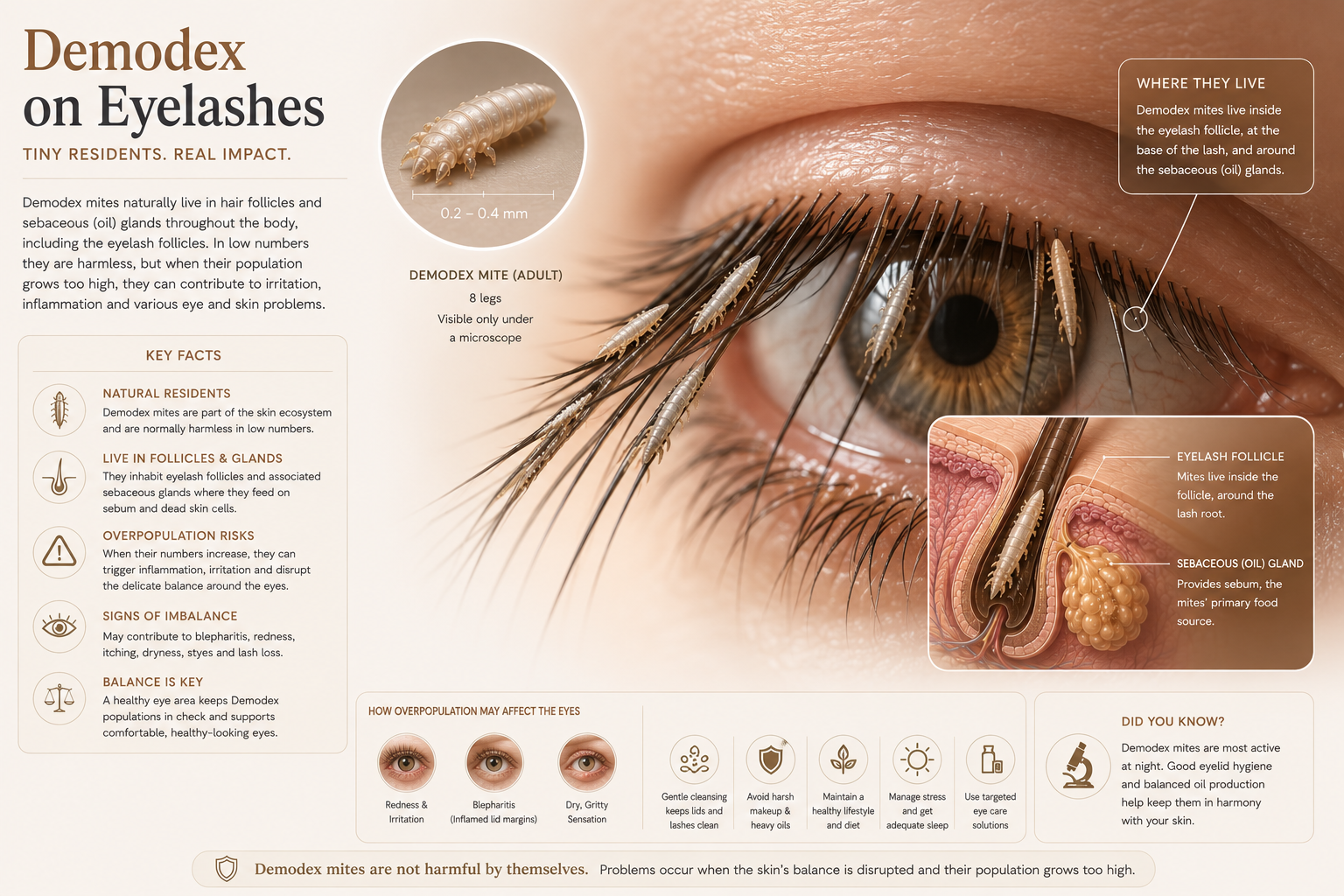
Demodex on Eyelashes

Illustration of Demodex mites within an eyelash follicle and along the eyelid margin
Figure 5: Illustration of Demodex mites within the eyelash follicle and eyelid-margin environment.

Demodex mites can also inhabit the eyelash follicles and eyelid margins. Demodex folliculorum is commonly found within eyelash follicles, while Demodex brevis can inhabit associated sebaceous and Meibomian glands. Small populations may be present without causing noticeable discomfort.

Higher Demodex densities at the eyelid margin have been associated with Demodex blepharitis. Collarettes (cylindrical debris) around the base of the eyelashes are commonly associated with this condition, while symptoms such as eyelid redness, itching, and irritation can have other causes and should not be considered evidence of Demodex on their own.

Gentle eyelid-margin hygiene can help keep the eyelids and eyelashes clean and comfortable. Products used around the eyes should be specifically formulated for that area and used according to their directions.

Key Facts: Demodex on Eyelashes

  • Demodex folliculorum is commonly found within eyelash follicles.
  • Demodex brevis can inhabit associated sebaceous and Meibomian glands.
  • Higher Demodex densities at the eyelid margin have been associated with Demodex blepharitis.
  • Collarettes around the eyelash base are commonly associated with Demodex blepharitis.
  • Gentle eyelid hygiene can help keep the eyelid margins clean and comfortable.
Educational Note: This information is provided for educational purposes only and is not intended to diagnose, treat, cure, or prevent any medical condition. If you experience persistent eye discomfort, consult an eye care professional.